How soft, air-driven materials can sense, respond and care.

柔软的、由空气驱动的材料如何感知、回应与关怀。

01 — CO-DESIGNING NECK SUPPORT WITH AN FSHD PATIENT

FSHD: facioscapulohumeral muscular dystrophy

FSHD:面肩肱型肌营养不良症

Zhang, Z., Yang, Y., Liu, J., Shen, D., Parati, I. Co-Designing Interactive Inflatable Head Supports with People Living with FSHD: Needs, Prototypes, and Design Implications. HCI International – UAHCI (under review).

In what ways do existing neck supports fail people living with FSHD?

现有的颈部支撑,在哪些方面无法满足 FSHD 患者的需求?

FSHD is a hereditary, progressive muscle disease in which neck weakness and pain are common — and often uneven between the left and right sides. Most commercial collars are designed to immobilise the neck after trauma. Together with a person living with FSHD, we co-designed an inflatable head support made of TPU film: airbags shaped from a scan of her head and neck conform to the jaw and neck, while a stack of airbags beside the jaw inflates or deflates to assist head rotation.

FSHD 是一种遗传性、进行性的肌肉疾病,颈部无力和疼痛很常见,而且左右两侧往往不对称。市面上大多数颈托是为创伤后固定颈椎而设计的。我们与一位 FSHD 患者共同设计了一款由 TPU 薄膜制成的充气头部支撑:气囊根据她头颈部的扫描数据成型,充气后贴合下颌与颈部;下颌一侧的叠层气囊可以充气或放气,辅助头部转动。

RoleFramed the research logic and led its inflation simulation, TPU prototyping and structural testing.

角色构建研究框架与逻辑,并主导充气仿真、TPU 原型制作与充气结构测试。
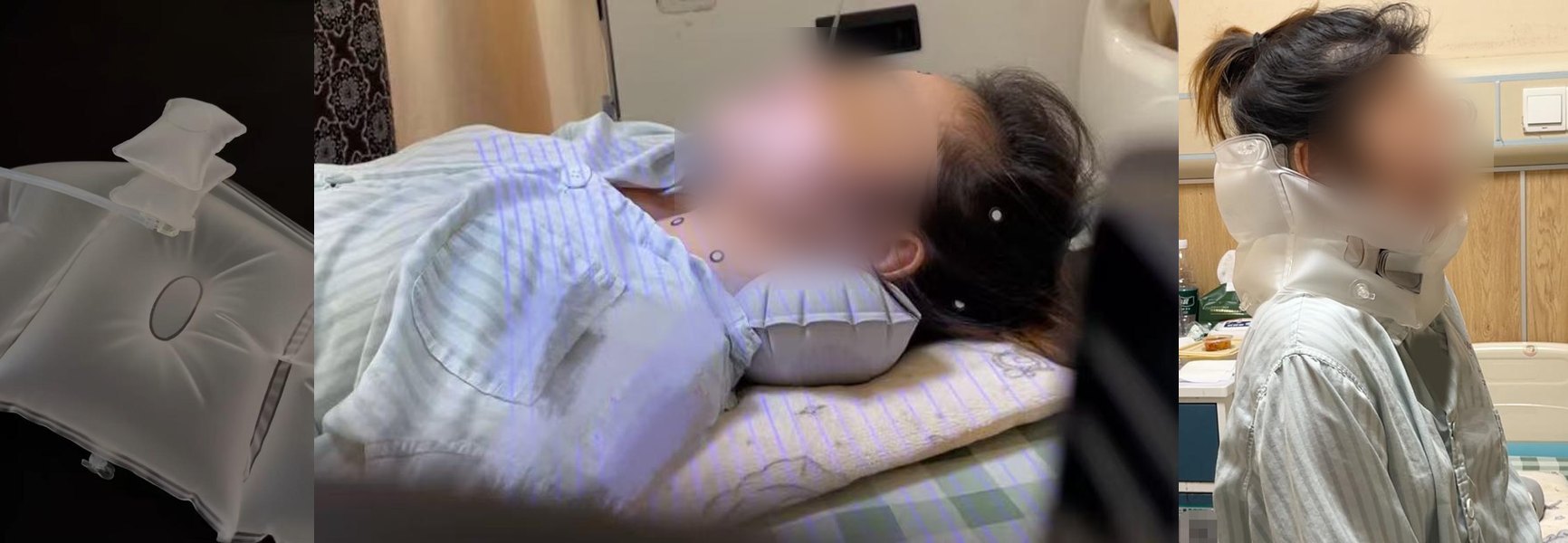
Stacked airbags on the first prototype, laser scanning of the participant's head and neck, and the participant wearing the prototype (faces blurred)

02 — SWEAR+

Chang, Y.*, Zhang, Z.*, Liu, T., Chen, Y., Guo, M., Gao, Z.† (2026). SWEAR+: Embodied Empathy for Hyperhidrosis through Material-Based Interaction and Fluidic Actuation. UbiComp Companion ’26, ACM. (Demo) ↗

* equal contribution · † corresponding author

* 共同第一作者 · † 通讯作者

Can a wearable help others feel what hyperhidrosis is like?

可穿戴设备能否让他人体会手汗症的感受?

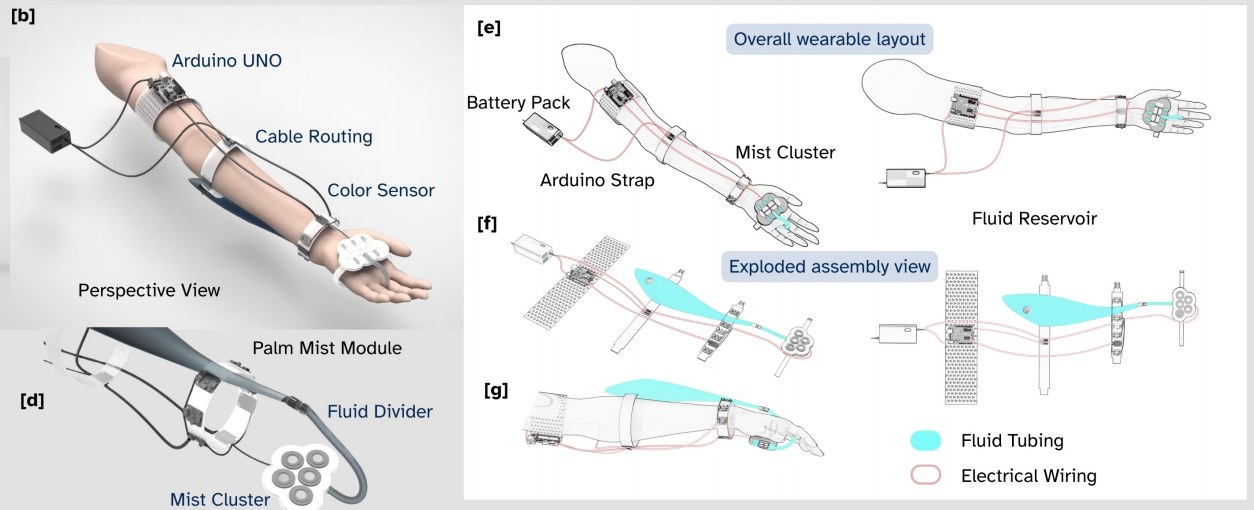
Palmar hyperhidrosis — excessive sweating of the hands — is common yet rarely talked about, and its social and emotional weight is easy to underestimate. SWEAR+ explores an empathy wearable that lets others experience the sensation, turning a hidden condition into a shared, felt understanding.

手汗症(手掌多汗)并不少见,却很少被谈论,它带来的社交与情绪负担也常被低估。SWEAR+ 探索一种共情可穿戴设备,让他人亲身体验这种感受,把一种隐藏的病症转化为可被共同感知的理解。

RoleCo-led the project and its engineering — fluidic architecture, embedded control and iterative prototyping of the palm actuation cluster.

角色共同领导项目并负责工程方向,包括流体架构、嵌入式控制系统及手掌驱动集群的迭代原型设计。

SWEAR+ system: perspective view, wearable layout and exploded assembly of the palm mist module, fluid tubing and wiring

03 — COMPUTATIONAL INFLATABLE STRUCTURE FOR SOLAR-RESPONSIVE BUILDING ENVIRONMENT

Liu, J., Parati, I., Zhang, Z. A Computational Design Framework for Programmable Inflatable Sheets: From Seam Patterning to Solar-Responsive Building Envelopes. CAADRIA 2027 (under review).

Can a seam pattern program how a sheet moves — and how much sun it lets in?

焊缝图案能否设定薄膜如何变形,以及让多少阳光透过?

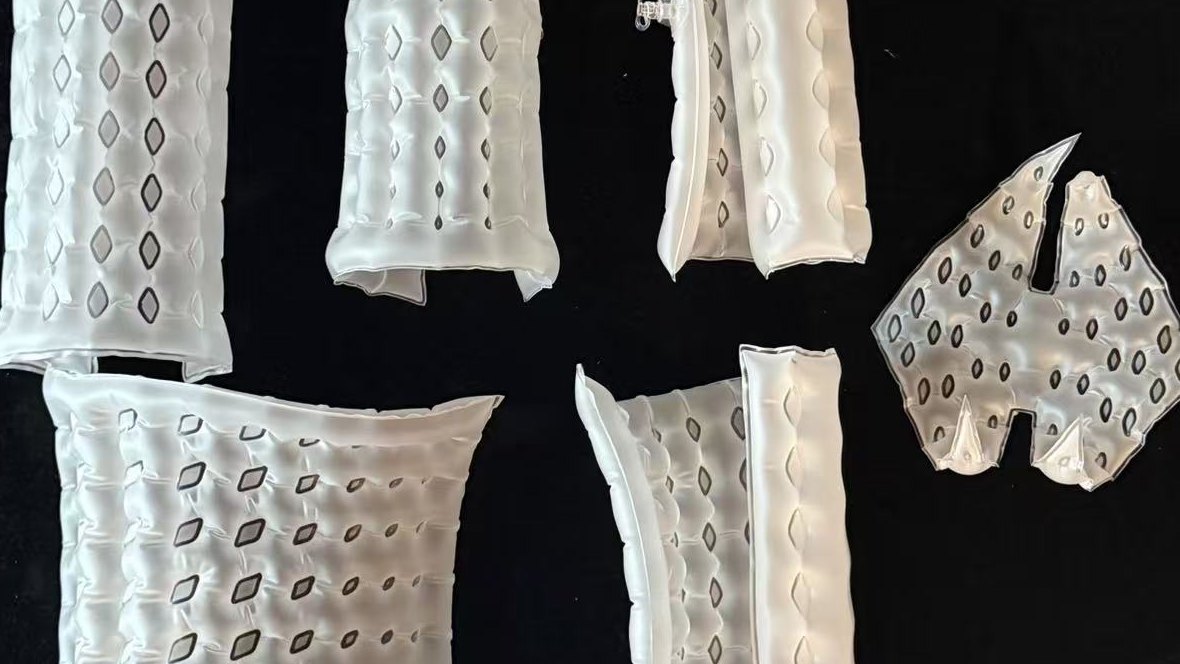
Adaptive building envelopes usually move through motors, hinges and rigid frames. This research embeds transformation directly into a thin pneumatic sheet: two membranes joined by designed heat-sealed seam fields bend, curl and twist when pressurised. A computational framework links a rhombille-based seam grammar, nonlinear inflation simulation and CNC heat-sealing, showing that seam geometry encodes distinct deformation families — in one case reducing projected area by 34.2% — and scales into a solar-responsive aperture matrix.

自适应建筑表皮通常依靠电机、铰链和刚性框架来运动。本研究把形变直接嵌入一张薄薄的气动薄膜:两层膜通过设计好的热封焊缝连接,充气时会弯曲、卷曲和扭转。我们建立了一套计算框架,把基于菱形镶嵌的焊缝语法、非线性充气仿真与 CNC 热封制造串联起来。结果表明,焊缝几何能够编码不同的形变类型——在一个案例中投影面积减少了 34.2%——并可扩展为一个随日照响应的开孔矩阵。

RoleDesigned the inflatable structural topologies and validated them through simulation, helping translate the concept into buildable structures.

角色负责充气结构的拓扑设计与仿真验证,协助将概念落地为可实现的结构。

Six heat-sealed TPU inflatable sheet prototypes with diamond seam patterns, curling and bending on a black board

04 — WEAVING INTIMACY

Parati, I., Corti, E., Zhang, Z. (2026). Weaving Intimacy: Textile-Based Soft Robotics for Responsive and Caring Environment. xArch 2026, Springer, pp. 341–348. ↗

Could the textiles around us respond with care?

我们身边的织物,能否以关怀作出回应?

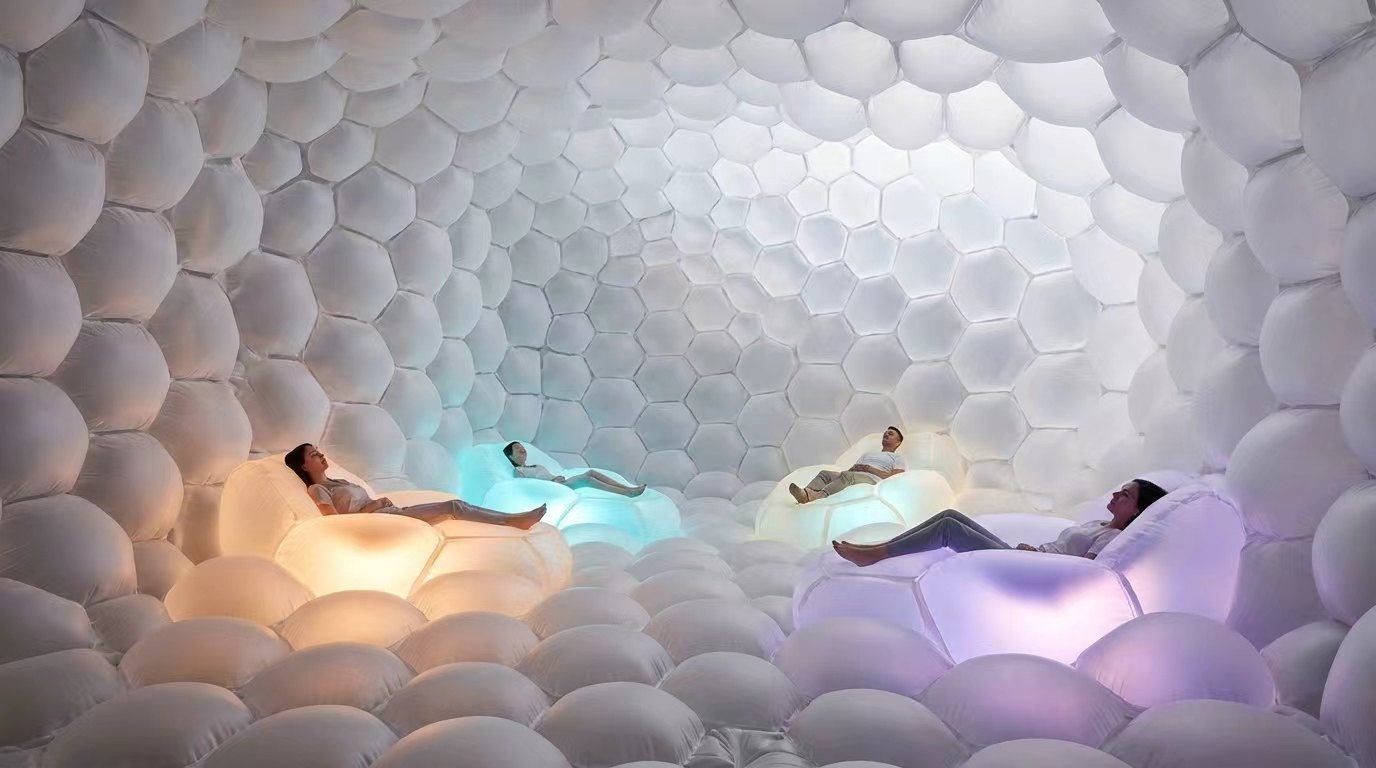
Textiles are the most intimate materials we live with — on our skin, in our beds, around our rooms. Weaving Intimacy embeds pneumatic actuation into woven and textile structures, imagining soft environments that sense presence and respond with warmth, support and touch.

纺织品是我们最亲密的材料——贴近皮肤、铺在床上、环绕房间。Weaving Intimacy 将气动驱动融入编织与纺织结构,设想能够感知人的存在、并以温度、支撑与触感作出回应的柔性环境。

RoleConceived and iterated the inflatable prototypes and embedded actuators.

角色负责充气原型与嵌入式驱动器的构思与迭代。

People resting in glowing inflatable seats inside a soft cellular inflatable enclosure

05 — ARTCLUE

Corti, E., Parati, I., Chen, C., Yao, X., Su, K., Xia, M., Wen, X., An, P., ten Bhömer, M.* (2026). ArtClue: A Pneumatic Wearable for Embodied Art Therapy. UbiComp/ISWC ’26 Design Exhibition, Shanghai, 13–15 Oct.

Special support: Zhe Zhang — technology support

特别支持:章喆 —— 技术支持

* corresponding author

* 通讯作者

Can gentle inflation guide us back into our own bodies?

温和的充气触感,能否引导我们重新回到自己的身体?

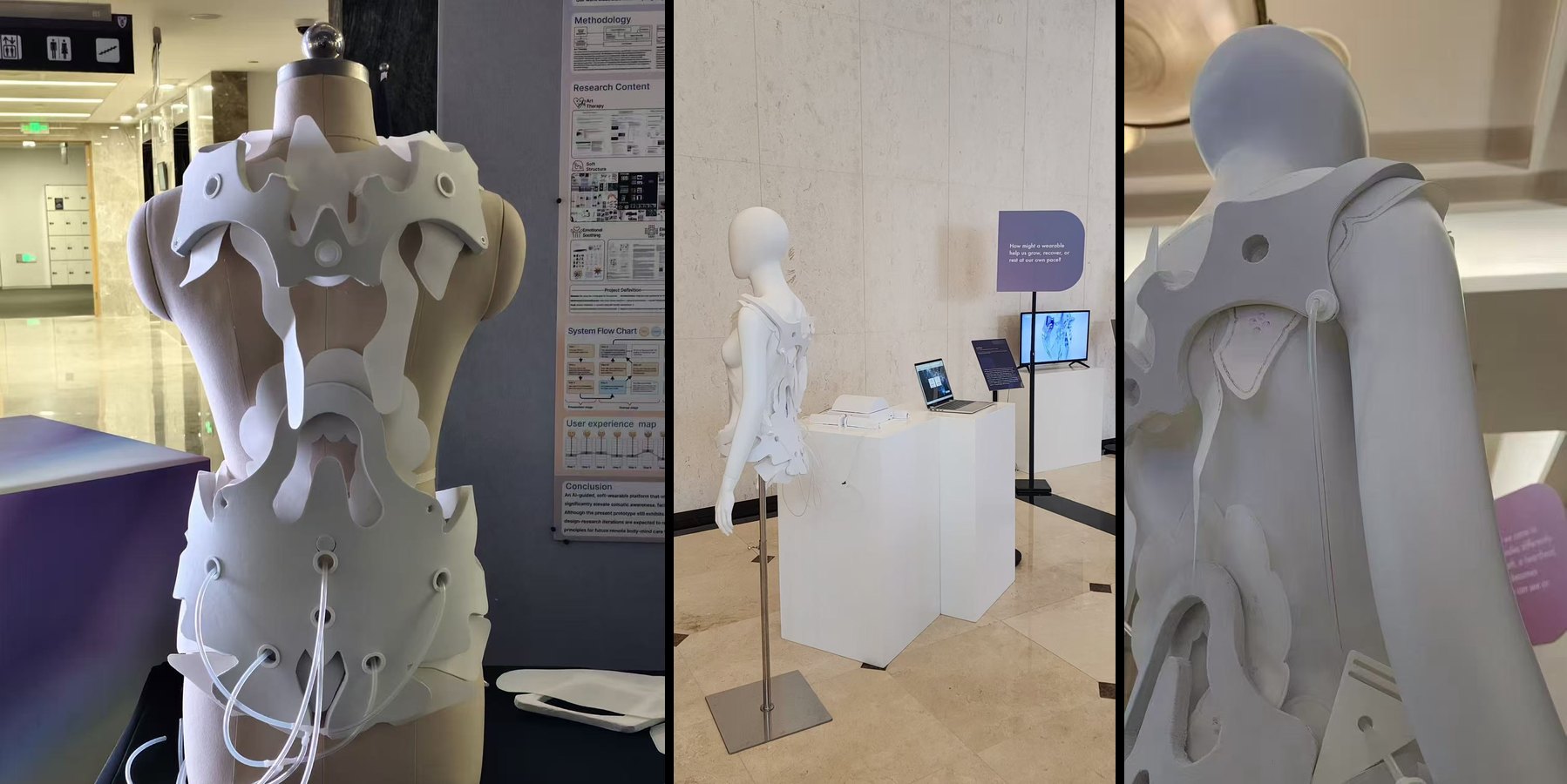
Art therapy homework is crucial for progress, yet clients often struggle when practising unguided. ArtClue is a multimodal probe in which an AI agent guides a body scan while a pneumatic wearable delivers synchronised, localised inflation cues across the shoulders and waist. Coupling haptic feedback with drawing and writing deepens self-attunement, supports creative flow and points towards remote somatic self-care.

艺术治疗的课后练习对疗效至关重要,但来访者在没有引导时往往难以坚持。ArtClue 是一个多模态探针:AI 引导使用者进行身体扫描,同时气动可穿戴设备在肩部与腰部同步发出局部充气提示。触觉反馈与绘画、书写的结合,加深了自我觉察,支持创作的流畅性,也为远程的身心自我照护提供了可能。

RoleDeveloped and fabricated the soft pneumatic structures, leading air-circuit experimentation and manufacturing through Air Sketch.

角色负责软体气动结构的开发与制造,并通过 Air Sketch 主导气路实验与生产。

ArtClue pneumatic wearable on a dress form, at the UbiComp/ISWC 2026 Design Exhibition, and a close-up of the shoulder airbags

How robots without human bodies can move expressively — choreography, notation and light for a six-axis arm.

没有人类身体的机器人如何富有表现力地运动——为六轴机械臂设计的编舞、记谱与光。

01 — ROPERA

A non-humanoid robotic arm performer inspired by Kunqu Opera

受昆曲启发的非人形机械臂表演者

Can a robot without a human body still perform?

没有人类身体的机器人,也能表演吗?

Ropera is a six-axis robotic arm performer that moves beyond the anthropomorphic paradigm. Drawing on the codified gestures of Chinese Kunqu Opera, we developed a movement notation tailored to the arm’s joints — mapping pose, timing and pauses into choreography — and visualised the performance through light painting with fibre-optic sleeves.

Ropera 是一位跳出拟人化范式的六轴机械臂表演者。我们借鉴中国昆曲程式化的身段,针对机械臂的关节开发了一套动作记谱法,把姿态、节奏与停顿转化为编舞,并通过光纤袖套的光绘将表演可视化。