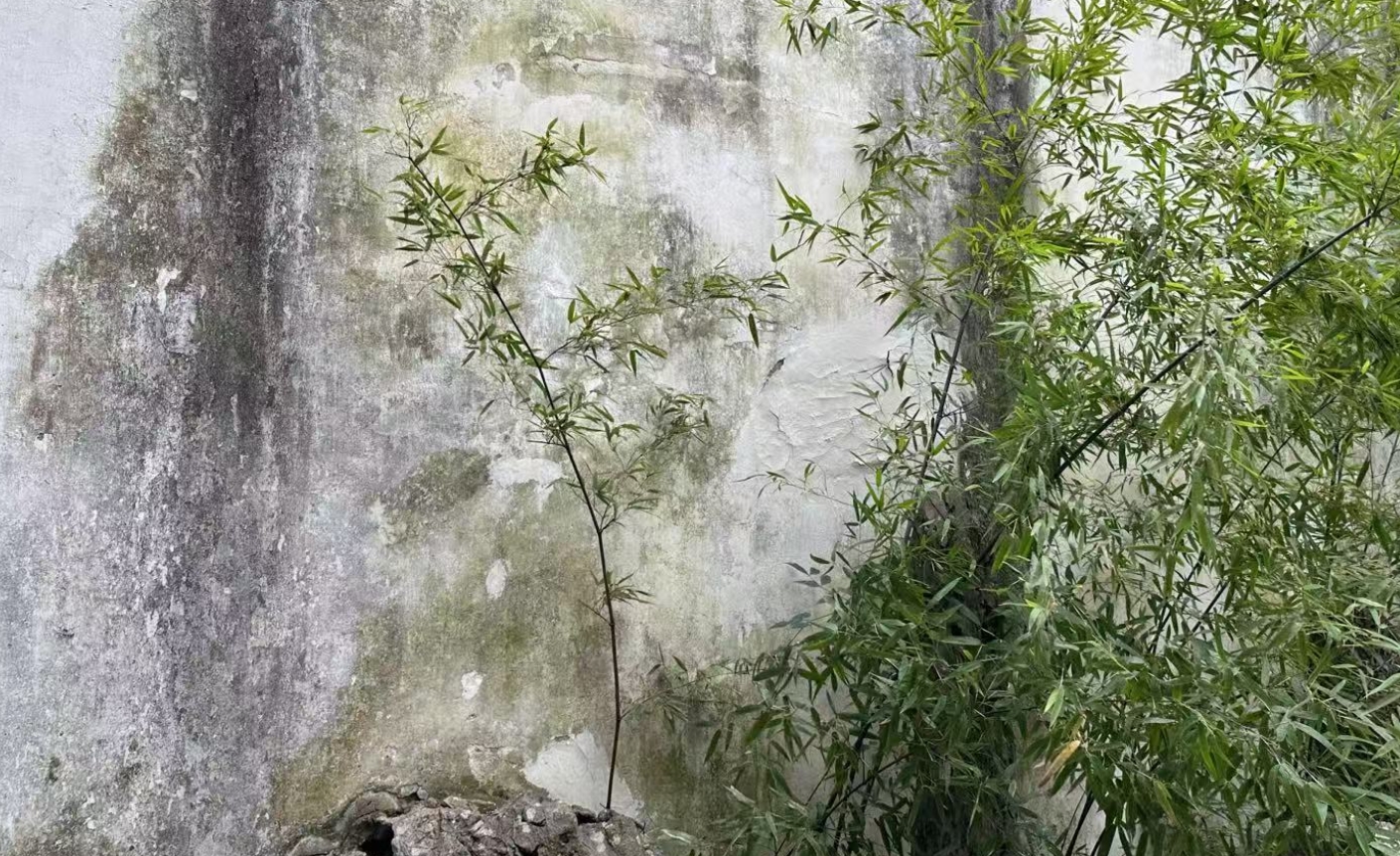
When I wander through a Suzhou garden, I notice that moss seems like time’s imprint upon space—slowly growing and covering stone surfaces, bearing witness to the passage of seasons. Moss not only carries the sediment of time but also hints at the layered dimensions of space. This “spatio temporal” quality parallels the concept of wave-particle duality: on one hand, moss spreads continuously like a wave; on the other, it freezes in place at certain moments, as though it becomes a particle that merges into the space.
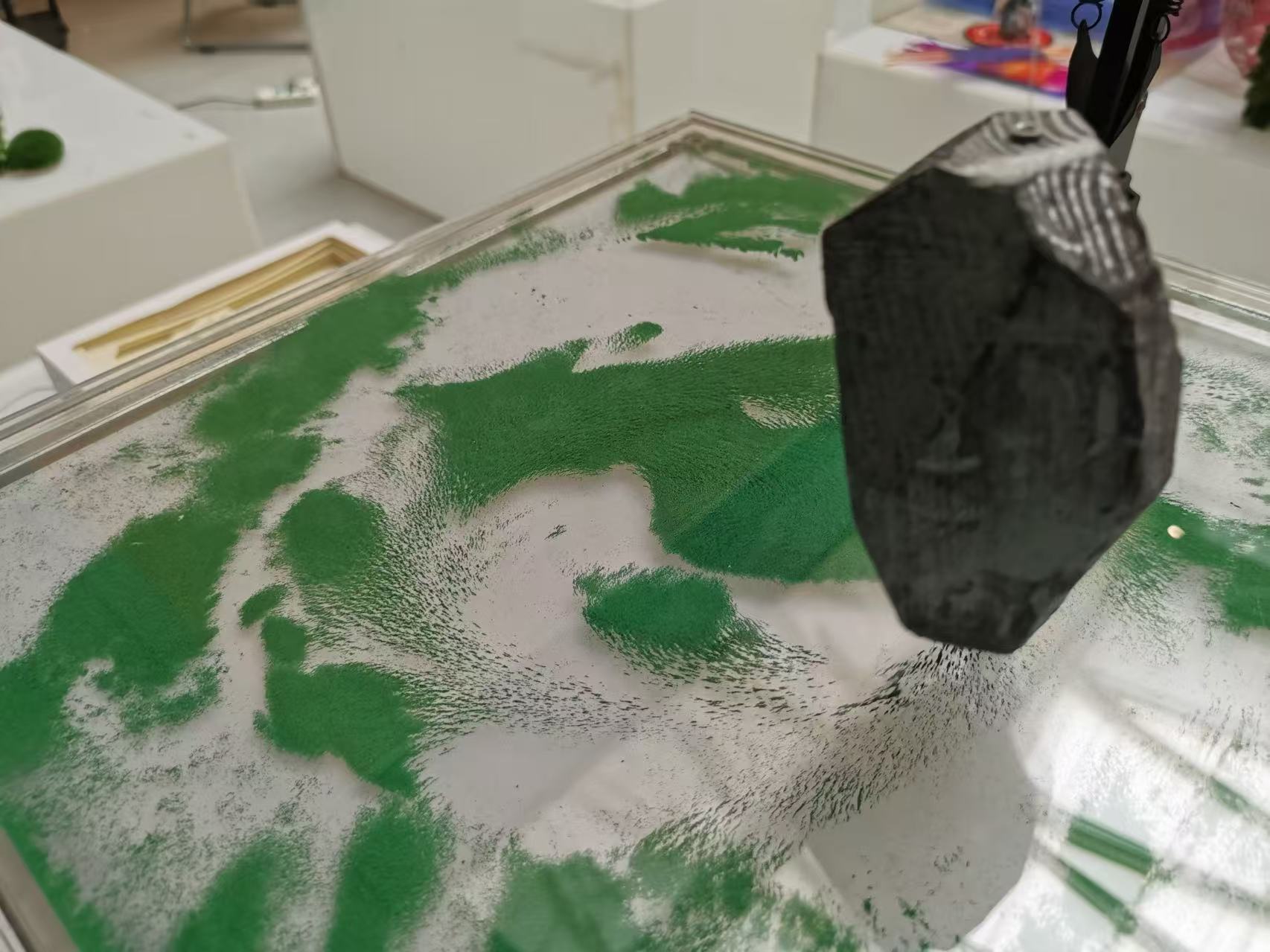
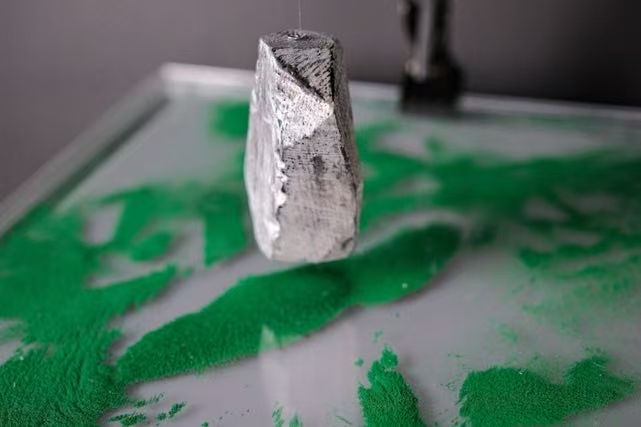
In my installation, I use a magnet attached to a pendulum to represent the wave-like nature of time. As it swings back and forth, the magnet influences iron powder on the surface below—those particles stand in for the “particles” of time. Under the interference of the magnetic field, the powder sometimes clusters, sometimes scatters, producing random, moss-like patterns.
Through repeated interactions between the pendulum and the powder, the installation perpetually “writes” and “rewrites” these moss-like tracings on the surface. The pendulum’s regular motion suggests the orderly flow of time, while each interference creates unexpected, shifting forms, reflecting the irreversible and unpredictable aspects of passing moments. In this way, wave-like continuity and particle-like fixation intertwine, mirroring the spatiotemporal experience of the garden: time flows steadily, yet leaves tangible traces at certain points—just as moss etches itself onto the stone.
This installation presents a “moss of time” for viewers. Every swing rearranges the powder into a singular pattern, echoing how moss grows—slow and enduring, yet also prone to sudden changes. By merging the garden’s sense of time and space with the quantum notion of wave-particle duality, I hope to make people aware that we, too, are traversing a similar temporal dimension. We drift along in the wave of time, yet are simultaneously crystallized into unique “particles” in each moment. It’s precisely this dual awareness—of the uncertainty of time and its visible traces—that connects the “moss marks” in a Suzhou garden with the interference patterns in this installation, offering us fresh insight and reflection on the relationship between time and space.
漫步苏州园林时,我注意到苔藓仿佛是时间在空间中留下的印记——它缓慢生长,覆盖石面,见证四季流转。苔藓不仅承载着时间的沉积,也暗示着空间的层叠维度。这种“时空”特质与波粒二象性的概念相呼应:一方面,苔藓像波一样连续蔓延;另一方面,它又在某些时刻凝固于原处,仿佛化为粒子融入空间。
在这件装置中,我用一块挂在摆锤上的磁铁来表现时间的波动性。磁铁来回摆动,影响下方表面的铁粉——这些铁粉代表时间的“粒子”。在磁场的干扰下,铁粉时而聚集、时而散开,形成随机的、如苔藓般的图案。
通过摆锤与铁粉的反复作用,装置在表面上不断“书写”又“重写”这些苔痕。摆锤规律的运动暗示时间有序的流动,而每一次干扰都会产生意想不到、不断变化的形态,映射出时光流逝中不可逆、不可预测的一面。波的连续与粒子的定格就这样交织在一起,正如园林中的时空体验:时间稳定地流淌,却在某些节点留下可触的痕迹——就像苔藓刻进石头。
这件装置为观者呈现了一片“时间之苔”。每一次摆动都会把铁粉重新排列成独一无二的图案,呼应苔藓的生长方式——缓慢而持久,却也会骤然改变。通过把园林的时空感与量子的波粒二象性结合在一起,我希望让人们意识到,我们同样穿行在类似的时间维度中:我们随时间之波漂流,又在每一个瞬间凝结为独特的“粒子”。正是这种对时间不确定性及其可见痕迹的双重觉察,把苏州园林中的“苔痕”与这件装置中的干涉图案联系在一起,为我们思考时间与空间的关系提供新的视角。